A 1 week intensive driving course with test sounds simple: five days of lessons, then your practical test at the end of the week. In practice there is a bit more to it, especially since the GOV.UK booking rules changed in 2026. This guide explains how a one week driving course with test actually works, what each day usually looks like, who it suits, and what happens if the test does not go your way.
If you are new to the idea of learning in a block rather than weekly lessons, our main intensive driving courses page gives the wider picture. Here we focus on the week itself.
What is a 1 week intensive driving course with test?
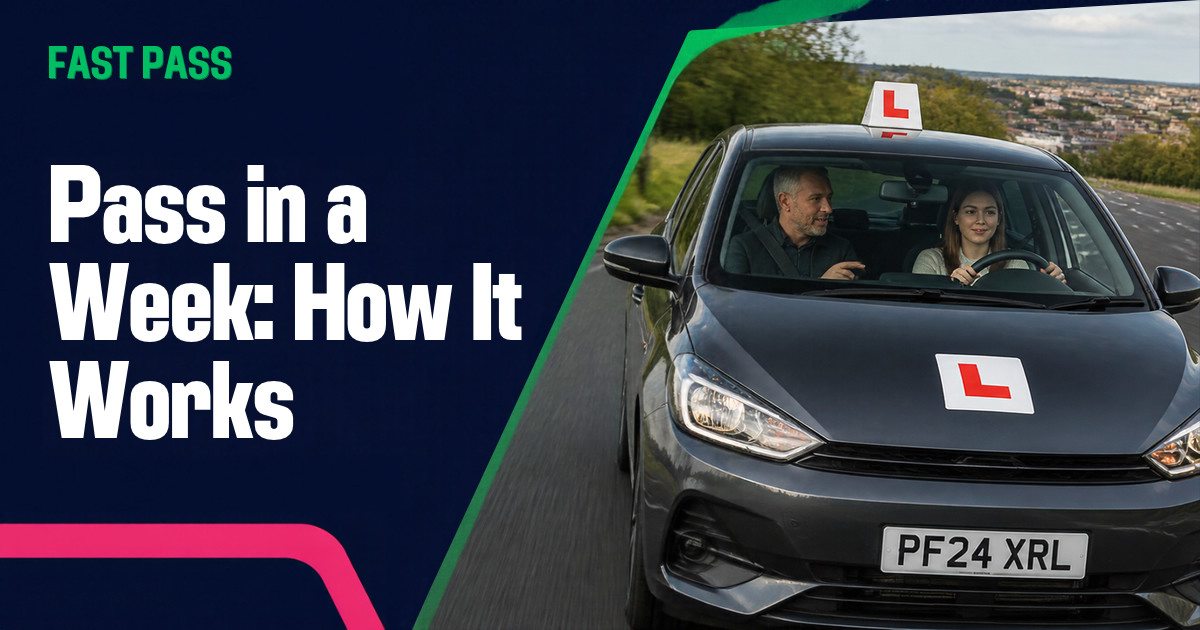
It is a block of driving lessons, usually spread over five consecutive weekdays, with your practical driving test timed for the end of the course. Instead of one or two hours a week over several months, you might drive for several hours a day with the same instructor, in the same car, on the roads around your test centre.
The appeal is obvious. You keep momentum, you do not forget last week's lesson, and you spend the whole week practising the kind of routes and junctions you are likely to meet on test day. Many people also like having a clear finish line.
What a course cannot do is skip the learning. The hours still have to be done; they are just packed closer together. That is why the right course length depends heavily on your starting point, which we cover below.
Before the week starts: theory test and test booking
Two things need to be in place before a five day intensive driving course with test can work.
1. A pass in your theory test
You must pass your theory test before you can book a practical test. The car theory test currently costs £23 on GOV.UK. If you have not taken it yet, our theory test help page is a good place to start, and it is worth getting it done well before you plan your course.
2. A practical test date, booked by you
This is the part that changed in 2026. Under the new rules, only the learner can book, change or cancel their own car driving test. Driving instructors, driving schools and third-party booking services are no longer allowed to do it for you. The key changes were:
- From 31 March 2026: you can make a maximum of two changes to a test booking (it used to be six).
- From 12 May 2026: only learners can book and manage their own car test.
- From 9 June 2026: if you move your test, you can only move it to one of the three test centres nearest to the one you originally booked.
You can read the official announcement on GOV.UK. The practical car test costs £62 on weekdays and £75 for evenings, weekends and bank holidays (tests starting from 4:30pm count as evening tests), according to the official fee page.
In practice, this means your course is usually planned around a test date you already hold, rather than the other way round. Your instructor can still advise you on whether you are ready and help you pick a sensible week, but the booking itself is in your name and under your control. If you are struggling to find a date, our fast track practical test page explains the support available, and our guide to why driving test waiting times are still long in 2026 covers your options in more detail.
How the week usually runs, day by day
Every instructor adapts the plan to the pupil, so treat this as a typical outline rather than a fixed timetable. It assumes a five day course with the test on the final day.
| Day | Main focus |
|---|---|
| Day 1 | Assessment drive, cockpit drill, controls, moving off and stopping, quieter roads, basic junctions |
| Day 2 | Junctions, roundabouts, mirrors and signals, meeting traffic, pedestrian crossings |
| Day 3 | Busier roads, dual carriageways, the reversing exercises, emergency stop practice |
| Day 4 | Independent driving with sat nav and road signs, test centre area routes, full mock test |
| Day 5 | Warm-up drive, final tidy-up of any weak points, then the practical test |
Days are often split into two sessions with a proper break in between. Concentrating behind the wheel is tiring, and most people learn better with a rest than by driving for hours straight.
A mock test on day four is one of the most useful parts of the week. It shows you, and your instructor, exactly what still needs work while there is still time to fix it. Our guide to the mock practical driving test explains how to get the most from one.
What happens on test day
The car practical test lasts around 35 minutes and has four parts, as set out on GOV.UK:
- Eyesight check: reading a number plate from 20 metres (20.5 metres for an old-style plate). Failing this ends the test.
- Show me, tell me questions: one 'tell me' question before you drive and one 'show me' question while you are driving.
- General driving and independent driving: driving on a mix of roads, including a section of independent driving where you follow a sat nav, traffic signs, or both.
- A reversing exercise: parallel parking, parking in a bay, or pulling up on the right and reversing about two car lengths. You might also be asked to do an emergency stop.
To pass, you need no more than 15 driving faults and no serious or dangerous faults. On an intensive course, the last day's warm-up drive is about settling nerves and keeping your driving smooth, not cramming new skills.
Is one week realistic? Beginners vs part-trained drivers
This is the honest bit. Whether a one week crash course with test is realistic depends almost entirely on how much driving you have already done.
Part-trained learners
If you have already had a good number of lessons, can handle roundabouts and junctions on your own, and mainly need polishing, a one week course can be a very efficient way to get test-ready. The week is spent fixing faults, building consistency and learning the local area rather than starting from scratch.
Complete beginners
If you have never driven before, five days is a lot to ask. Some beginners do manage it, but many need more hours than a single week can comfortably hold. For a true beginner, a longer course, or a short block of lessons first followed by an intensive week, often gives a better chance on test day. Our article on intensive driving courses for beginners goes into this in more depth.
Signs a one week course is likely to suit you:
- You have had regular lessons before and are comfortable with the basic controls.
- You can drive through most junctions and roundabouts without prompting.
- You have passed your theory test and hold a test date.
- You can commit to a full week with no other big plans.
An assessment lesson before you book is the best way to find out. It is far better to choose a slightly longer course than to arrive at your test underprepared. You can also read a driving instructor's perspective on intensive courses for a view from the other side of the dashboard.
What if you fail your test at the end of the week?
Nobody can guarantee a pass, and anyone who promises one should be treated with caution. Plenty of good drivers fail on the day through nerves or a single serious fault.
If it happens, the examiner will explain the faults you made. You then need to book another test yourself on GOV.UK and pay the fee again, and the new date must be at least 10 working days away. Because waiting times vary around the country, the next available slot may be further off than that.
The good news is that the week's work does not disappear. Many learners book a few top-up lessons before their next test to keep their skills fresh and focus on whatever caught them out. Our guide on what to do after failing your driving test has practical steps to bounce back.
How to get the most from your week
- Sleep well. Long days of driving are mentally tiring, and tired drivers make more mistakes.
- Eat and drink properly during breaks so your concentration does not dip in the afternoon.
- Ask questions. If you do not understand why something counts as a fault, ask. The week moves fast.
- Revise show me, tell me questions in the evenings so they are second nature by test day.
- Keep the week clear of work shifts, exams and late nights where you can.
Frequently asked questions
Can you really pass your driving test in one week?
Some learners do, particularly those who already have driving experience. Complete beginners often need more hours, so a longer course may suit them better. An assessment lesson is the best way to judge.
Does an intensive driving course with test included book the test for me?
No. Since May 2026, only the learner can book, change or cancel their own car driving test on GOV.UK. Your instructor can advise on timing, but the booking must be made by you.
How many hours of driving is a 5 day intensive driving course with test?
It varies by course and by your experience. Courses are usually built around several hours of driving each day, with breaks. Your instructor can help you choose a course length that matches your current level.
What happens if I fail at the end of my crash course?
You book a new test on GOV.UK, pay the fee again and choose a date at least 10 working days away. Top-up lessons before the retest can help keep your skills sharp.
How much does a one week driving course with test cost?
Prices depend on course length, location and whether you learn in a manual or automatic. Our article on how much an intensive driving course costs in 2026 explains what affects the price.
Ready to plan your week? Have a look at our intensive course options to find a course length that fits your experience, or call us free on 0800 001 6417 for friendly advice on whether a one week course is right for you.